Transforming Knowledge Systems for Life on Earth: Visions of Future Systems and how to get there

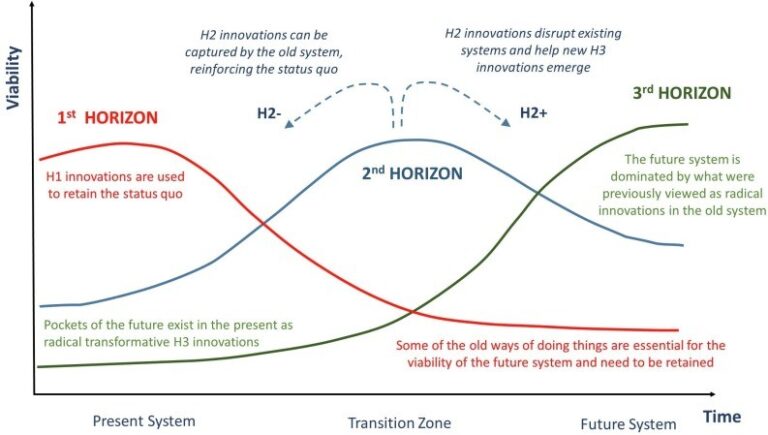
Fig. 1. The Three Horizons framework used to convene dialogue about how to achieve transformation. Each horizon represents a combination of particular ways of doing things (e.g. approach, technology, actions, values, mindsets). The viability of these ways change over time as surrounding conditions change, with the third horizon dominated system eventually emerging as more viable. The framework helps to identify: (1) Challenges that dominate the present that inhibit progress towards a more viable way of doing things (Horizon 1); (2) Features of a desired future systems (Horizon 3) and the innovations needed for new systems to emerge (Horizon 2). For the latter, distinctions are made between innovations that help create forward momentum (H2+) and those likely to be captured by existing systems and which can reinforce the status quo (H2−). This framework is not a theory, but rather seeks to support the practice of identifying pathways for system change.

Formalised knowledge systems are important but arguably failing humanity when their impact is measured against the level of progress being made in stimulating the societal changes needed to address challenges like climate change. In this research we used a novel futures-oriented and participatory approach that asked what future envisioned knowledge systems might need to look like and how we might get there.

Findings suggest that envisioned future systems will need to be much more collaborative, open, diverse, egalitarian, and able to work with values and systemic issues. To get to envisioned systems we will need to rapidly scale methodological innovations, connect innovators, and creatively accelerate learning about working with intractable challenges. We will also need to create new funding schemes, a global knowledge commons, and challenge deeply held assumptions. This will require bold and strategic action from governments, scientists, civic society and sustained transformational intent.

In: Energy Research & Social Science 70 (2020) 101724.

Diese Site ist auf wpml.org als Entwicklungs-Site registriert. Wechseln Sie zu einer Produktionssite mit dem Schlüssel remove this banner.